


From Exodus to Covenant: Virtual Exhibition
This browser cannot display the 3D room. All 12 works in the exhibition are listed below.
From Exodus to Covenant
A Journey from Bondage to Becoming
Lucien Krief Gallery, JerusalemSpring 2026
This exhibition offers a visual meditation on the Exodus—not only as a distant historical event, but as an ongoing inner movement, alive within every generation.
The series traces a path of transformation: from rupture and departure, through water and wilderness, toward revelation and the promise of the Land. Each painting reflects a distinct inner state along this journey—where fear meets courage, chaos yields to faith, and uncertainty opens into awakening.
These works do not seek to illustrate the narrative, but to evoke its essence—the density of sand, the force of water, the breath of the desert, the trembling before Sinai, the stillness that precedes arrival. What unfolds is not a story told, but an experience felt.
In the desert, one learns a different kind of trust. Manna appears each morning—not in excess, but in measure. There is always enough, yet never certainty. Sustenance becomes a quiet dialogue between need and faith.
Step by step, the journey becomes an act of trust.
Exodus is not only the act of leaving Egypt. It is the passage from confinement to openness, from darkness to light, from mere survival to a sense of calling.
Through layered textures, light emerging from matter, and the presence of small human figures within vast, open spaces, the paintings invite the viewer to enter the journey itself—to encounter both the vulnerability and the quiet strength of a people moving toward destiny.
This journey is not complete. It continues—within each of us.
Each time we choose not to yield to fear,
each step we take into the unknown,
each moment we dare to trust—
We participate in our own Exodus
Golda Koosh, Spring 2026
Works in the room
Moving around
- LookDrag with the mouse, or swipe sideways.
- View a workClick or tap a painting or its label. Enter opens the painting in front of you.
- WalkClick the floor, hold the arrow buttons, or use W A S D and the arrow keys.
- TourPlay starts the guided tour, K pauses it. P and N step through the works.
- ShareThe share button links to the painting you are viewing.
- Full screenF. Esc closes panels.
From Exodus to Covenant
A Journey from Bondage to Becoming
This exhibition offers a visual meditation on the Exodus—not only as a distant historical event, but as an ongoing inner movement, alive within every generation.
Preparing the room…
All works in this exhibition (12)
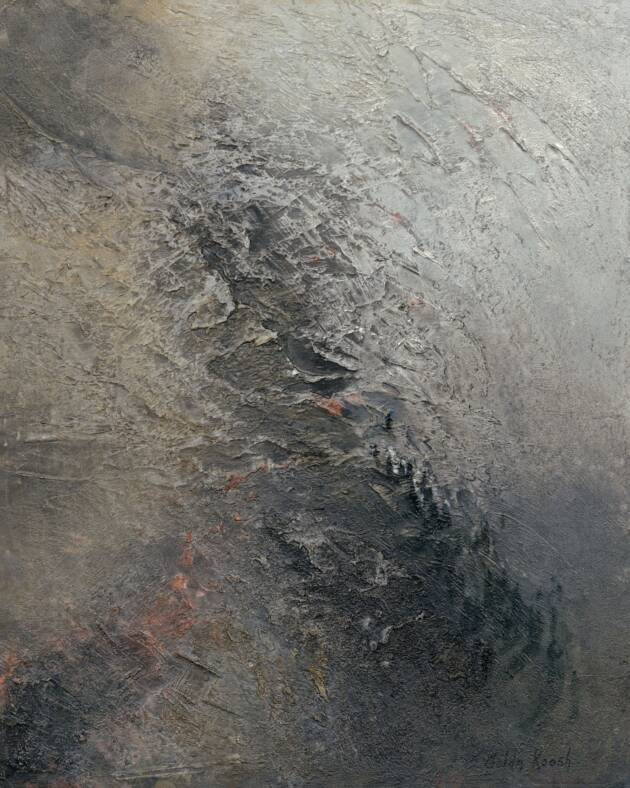
Exodus – Between the Fear of Leaving and the Courage to Depart
100×80 cm – 40×32 in
This work holds the charged instant of departure from Egypt—the point at which staying is no longer possible. The surface is dense, almost pressurized, like earth saturated with the weight of years in bondage. Matter feels compacted, burdened, carrying within it the residue of fear and the inertia of habit.
And yet, within this density, something shifts. A fissure forms—subtle at first, but irreversible. Exodus does not begin with spectacle or miracle, but with a decision: the recognition that the familiar can no longer sustain life. A first step is taken into the unknown.
There is no serenity here. Fear is present—of the desert, of uncertainty, of a future without promise. But alongside it rises a quiet, resolute courage: the willingness to move forward without assurance that the path will open.
The darkness does not part all at once. Light does not descend from above; it begins to emerge from within the fractures—like a fragile faith, newly awakened, not yet whole but undeniably alive.
This is the threshold moment—between past and future, between bondage and freedom.
Exodus is not only a historical event. It is a condition of the soul: the moment one dares to step beyond what is known, despite doubt, despite uncertainty, despite fear.
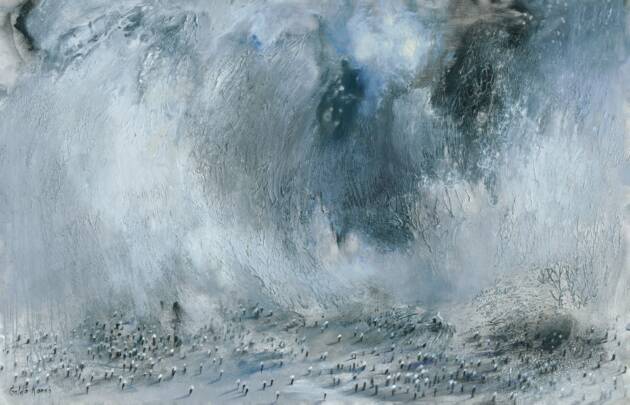
The Passage Through Water
90×140 cm – 35×55 in
The moment before the miracle—people move forward, unsure if the sea will hold.
The water is not yet salvation, the path not yet secure. Figures are fragile and numerous, advancing through a force that could close at any moment.
No celebration, only movement and the weight of continuing without guarantee.
Yet hope begins to emerge—not as certainty, but as the first echo of a song: the Song of the Sea, rising from support granted from Above
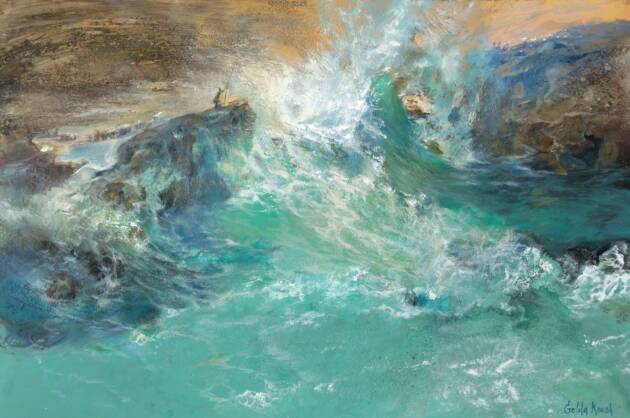
Where There Is No Path
100×150 cm – 39×59 in
Moshe stands at the edge of the unknown, leading his people toward freedom. Before him: the sea. Behind him: fear. He does not yet know the waters will part — but he walks forward, armed with nothing but faith and the strength of spirit.
It is this unwavering trust in the Divine that carves a path through the impossible, guiding him — and all who follow — toward the light
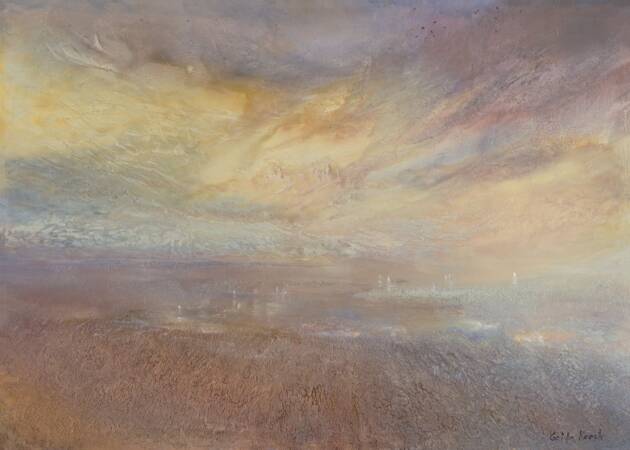
After the Crossing of the Sea
100×140 cm – 39×55 in
Behind them—the ordeal, and the miracle. The sea opened, and then closed its waters over those who pursued.
Before them—the desert. No return, and no solid ground ahead—only a path unfolding into the unknown. The salt still clings to the skin; the sand, damp and heavy, yields beneath each step.
Deliverance is not an ending. It is a threshold. Freedom begins here as wandering—long, unanchored, and unresolved—sustained by the fragile movement of search, and by a hope that has yet to take form
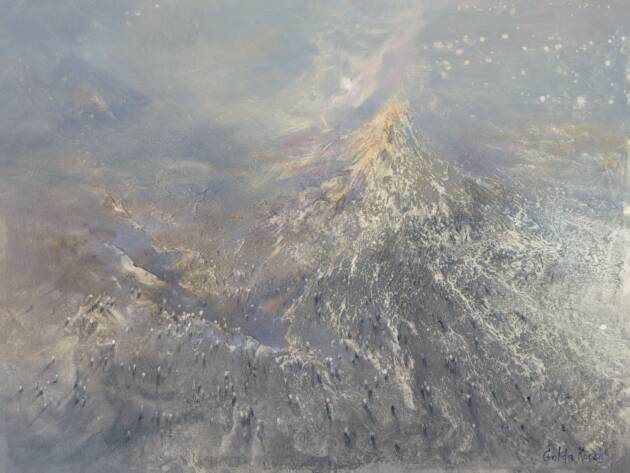
Mount Sinai: The Covenant
90×120 cm – 35×47 in
The Giving of the Torah at Mount Sinai marks the transformation of Exodus into responsibility and law.
Matter gathers toward the summit, where light appears as inner radiance — a presence, not an image.
Human figures are reduced to small, repeating traces at the mountain’s base, emphasizing the gap between the individual and the event. The Torah is given to an entire people at once.
This is a moment of acceptance: not thunder or fire, but the weight of choice and consent, where freedom becomes law
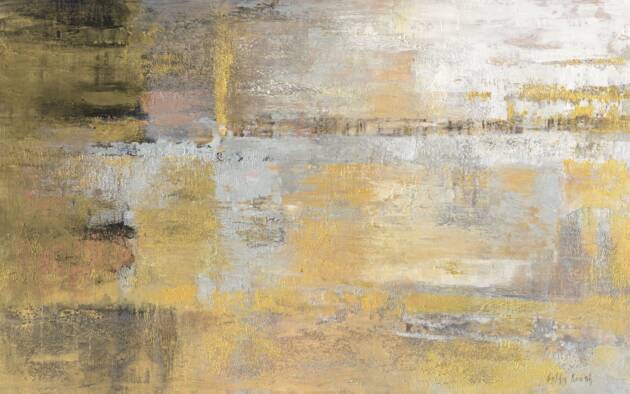
Mirages and Illusions of the Desert
100×160 cm – 39×63 in
This work reflects the continuation of the journey at the moment when orientation begins to dissolve.
The space appears open and luminous yet lacks stability. The boundaries between land, air, and reflection blur, and what seems like direction reveals itself as illusion.
The desert becomes a reflection of an inner state: we do not see reality itself, but its projection — shaped by our dreams and aspirations.
And it is precisely these dreams that give us the strength to move forward, to seek a path toward unity, and to trust in the Almighty.
Even when the way is unclear
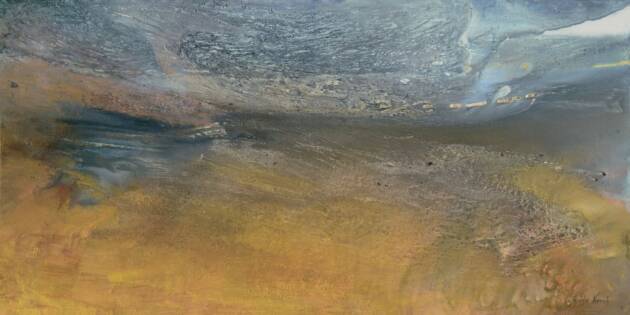
Desert Path
90×180 cm – 35×71 in
This abstract work evokes the Exodus emotionally rather than literally.
A dense weight of fear, habit, and memory of bondage resists release and makes departure difficult.
Light appears as a field of divine presence. Gold traces a path or a line of people seeking connection with the Divine—moving forward, not from certainty, but from faith.
Exodus is a process: a people becomes a people of covenant by choice, through persistence, trust, and courage in the unknown
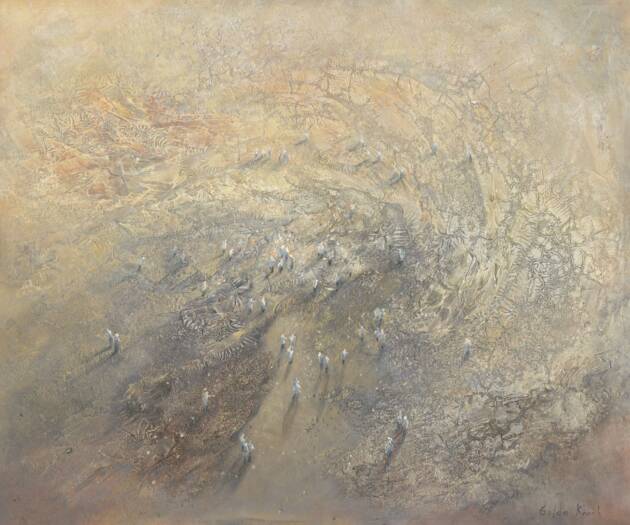
Manna from Heaven
100×120 cm – 39×47 in
Each morning, the manna appears upon the face of the earth—quiet, unannounced, like a gift that cannot be claimed, only received. Sustenance from above, meeting a people in the uncertainty of the desert.
They go out to gather: some take more, some less. Yet the measure remains just—the one who gathers much has nothing left over, and the one who gathers little knows no lack. Provision settles into a deeper order, beyond effort alone.
But the distance is not the same for all. For those who walk in goodness, the manna is found at the threshold of their tent, close at hand, as if the path itself bends toward them. Others must walk farther, into the open desert, to find what will sustain them. And still, when it is gathered, each one recognizes what is truly theirs.
In this, the work speaks of a quiet justice woven into the unseen: of trust, of measure, of recognition.
We move forward sustained not only by what we take, but by what is given. Trusting in the order that holds us, we continue the journey—knowing that even in the wilderness, we are not alone
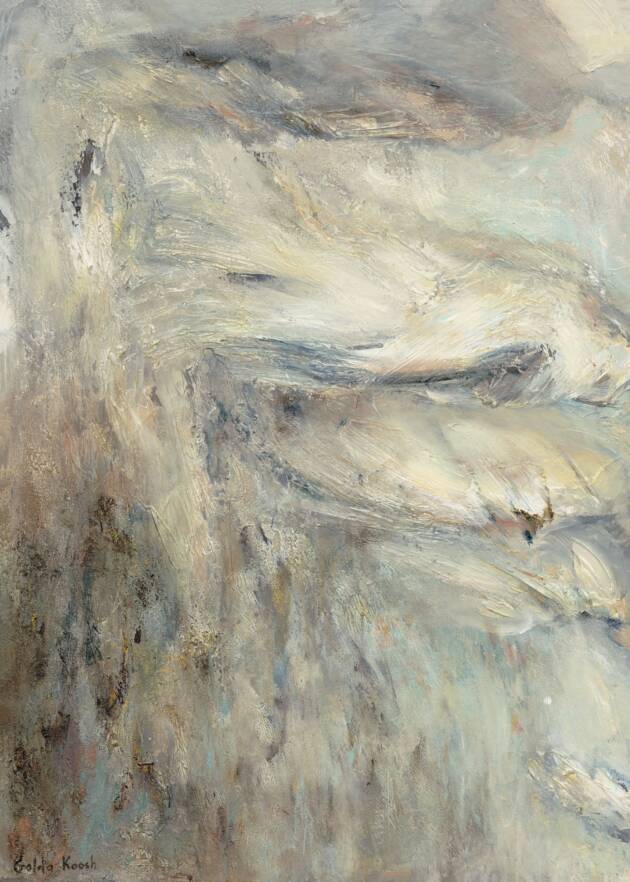
Generation of the Desert
100×140 cm – 39×55 in
From the mineral skin of the earth, human forms begin to emerge—fragile, almost dissolving into dust and light. They are the ones who left the bondage of Egypt and wandered the desert for forty years: a generation suspended between worlds. Freed from slavery, yet not fully prepared to bear the weight of freedom, they stood in a state of becoming.
They were not destined to enter the Promised Land. And yet, it was precisely this generation that gave shape to a people. To them, the Torah was given; through them, all that followed became possible.
In a deeper sense, each of us belongs to this generation of the desert. Time and again, we depart from our own forms of confinement—yet the journey remains incomplete, uncertain, unresolved.
In this work, the desert becomes a landscape of memory: a quiet, luminous space where the presence of those who made the future possible continues to endure
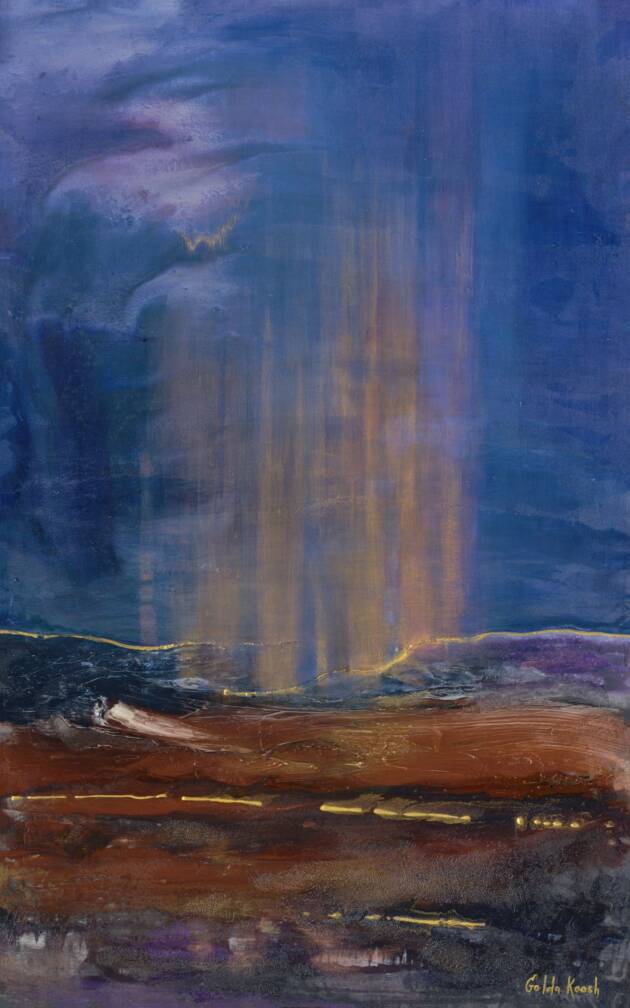
Light in the Desert (Pillar of Fire)
160×100 cm – 63×39 in
A vast darkness of earth and sky carries the weight of the journey—its doubt, its fear, its unspoken uncertainty. Within it, a light appears: the pillar of fire, guiding a people through night and wilderness, a quiet sign of presence and protection.
It does not soften the journey, nor does it remove the hardship. Instead, it reveals that a path exists—that even in obscurity, there is direction. And more than that, it affirms that the journey is not walked alone.
In moments of greatest difficulty, we seek this light within the darkness—not as a promise of ease, but as a reminder: that amid desert and trial, there remains a force that accompanies, that guards, that endures.
This work speaks of the human passage forward—of a people who continue to move, sustained by a fragile yet persistent faith in the light that leads the way
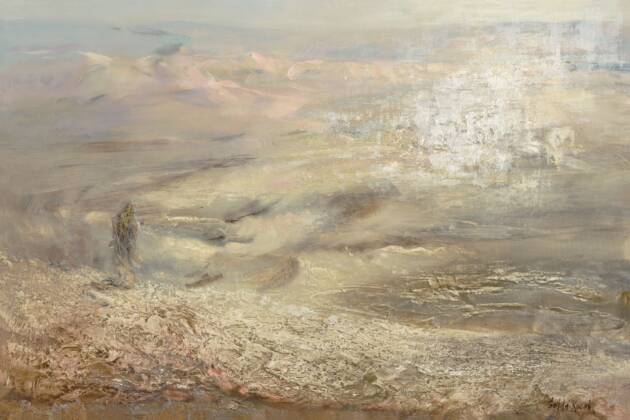
In Front of the Land – Moses on Mount Nevo
100×150 cm – 39×59 in
This painting captures the moment when Moshe sees the land he will never enter.
The figure stands at the edge of matter — almost dissolving into dust and light.
He is not a hero, nor the center, but a quiet density within the vast breath of space.
The horizon shimmers and shifts like a mirage — the land ahead existing somewhere between vision and reality.
Silver interruptions on the surface mark fractures in perception.
This is not a landscape. It is a threshold.
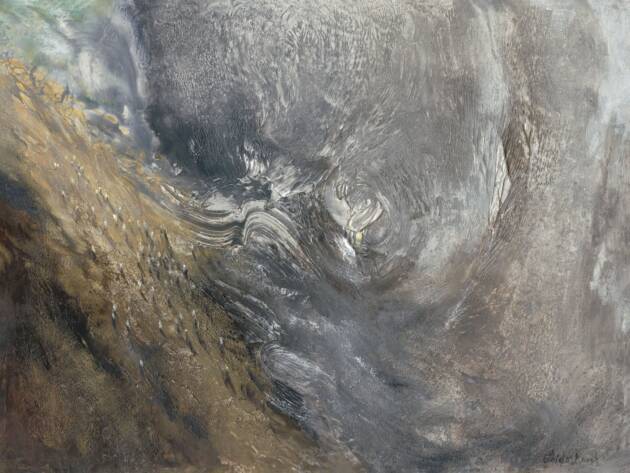
From the Wilderness into the Land (Crossing the Jordan River)
90×120 cm – 35×47 in
A generation raised in the wilderness—untouched by the chains of slavery, yet shaped to trust in the Divine and to rely on its guidance.
These are people formed within the vision of their own land, hearts prepared to claim it, to fight for it, to inhabit it fully.
And then comes the moment of crossing the Jordan. Only the Ark of the Covenant, carried by the Kohanim, holds back the river’s force. The waters pause, as they once did at the sea, and the people step across its bed—passing through a threshold, a portal of transformation.
From slavery into the wilderness, from the cradle of the desert into the struggle for their own land, into the responsibility of their own lives.
This is the journey of emergence, of becoming, of a people stepping into their destiny