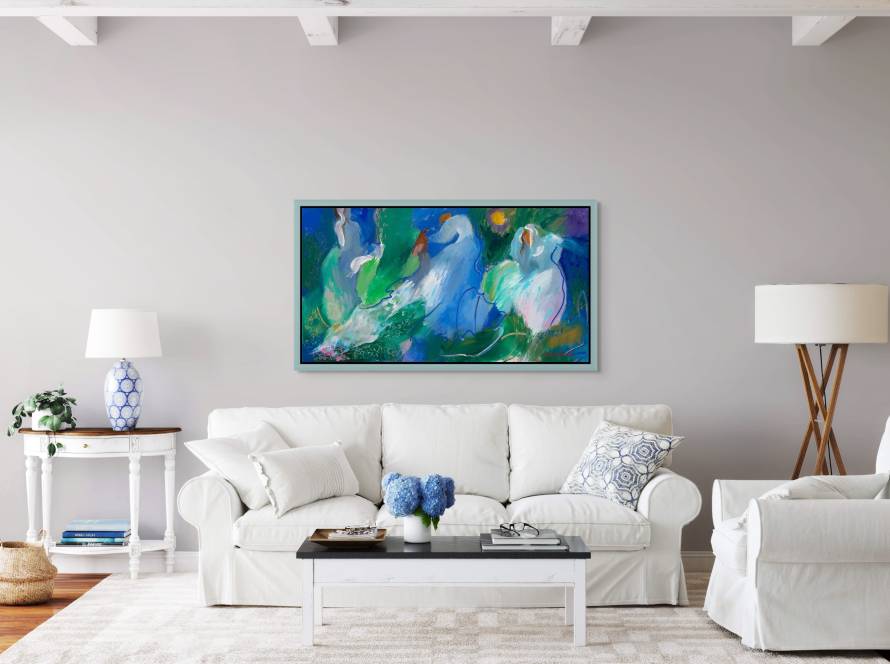
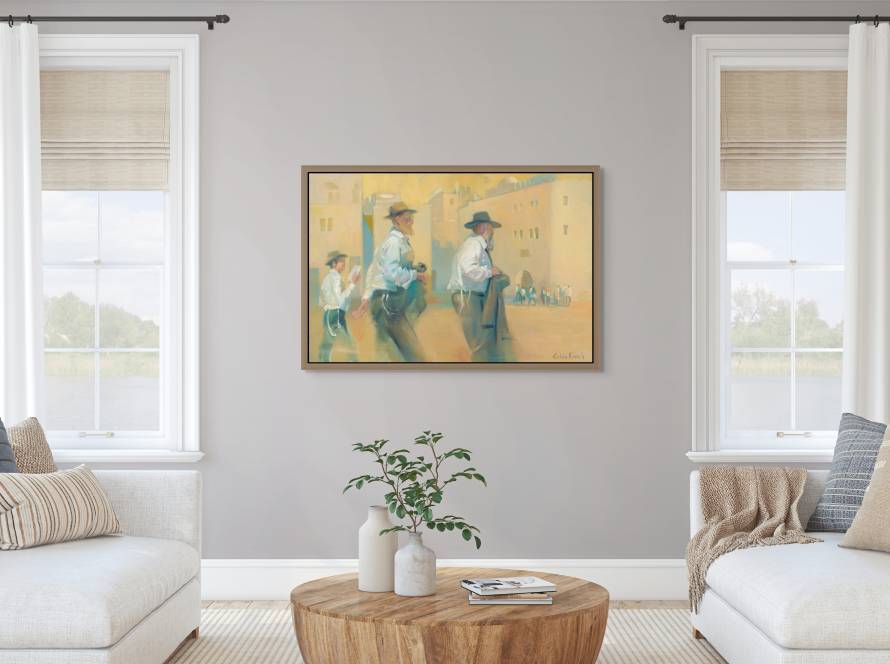
There is a moment on Friday evening when the world stops moving. The kitchen has finished its rush. The table is set with cloth and candlesticks. A woman stands at the counter, hands hovering above the Shabbat candles, and for a breath—just one breath—everything is still. The flames haven't been lit yet. The blessing hasn't been spoken. But you can feel it coming. That shift from work to rest, from the noise of the week to something quieter, deeper, more true.
This is the moment Golda Koosh captures in her Shabbat art paintings. Not the finished ritual, but the pause before it. The anticipation. The sacred space that lives in Jewish homes every Friday evening, carried through generations, painted now in warm golds and deep blues and the kind of light that only exists when time itself seems to slow.
Golda's Shabbat paintings are not about perfection. They are about the realness of the tradition, the way it settles into a Jewish home like a familiar prayer. You see the table with its simple abundance. You see the shadows on the walls. You see the human hands that will light the candles, speak the blessings, and begin the day of rest. Her brushstrokes capture something that photographs cannot: the feeling of peace that Shabbat brings, the way the entire week dissolves when you step into that space.
For more than a decade, Golda has been painting the rhythms of Jewish life from her studio in Jerusalem. The Holy City itself has shaped her vision, inspired her color palette, and deepened her understanding of what Jewish tradition means. When she paints Shabbat, she is not painting a religious obligation. She is painting home. She is painting the moment when a Jewish family gathers and says yes to rest, to connection, to something sacred.
Shabbat art paintings like hers remind us that the most meaningful moments in Jewish life are often the quiet ones. They happen in ordinary rooms, around ordinary tables, with ordinary light coming through ordinary windows. What makes them sacred is not grandeur but presence. It is the choice, made week after week, to honor the day. Golda's art celebrates that choice with color and warmth and an artist's deep understanding of what it means to live a Jewish life.
KEY TAKEAWAYS
- Shabbat art paintings capture the spiritual peace and anticipation of Jewish tradition through intimate, home-centered scenes rather than grand religious ceremonies
- Golda Koosh's Shabbat paintings use warm color palettes of golds, ochres, and soft blues to convey the restfulness and joy of the day of rest
- Her mixed media artwork emphasizes light and shadow to show how Shabbat transforms ordinary spaces into sacred moments in Jewish homes
- The artist's decade-long study of Jewish life in Jerusalem has shaped her ability to paint authentic, emotionally resonant scenes of Shabbat observance
- Collecting Shabbat art paintings connects you to a living tradition and brings the spiritual warmth of the day of rest into your own home year-round
The Artist Behind the Canvas
A Journey from Moscow to Jerusalem
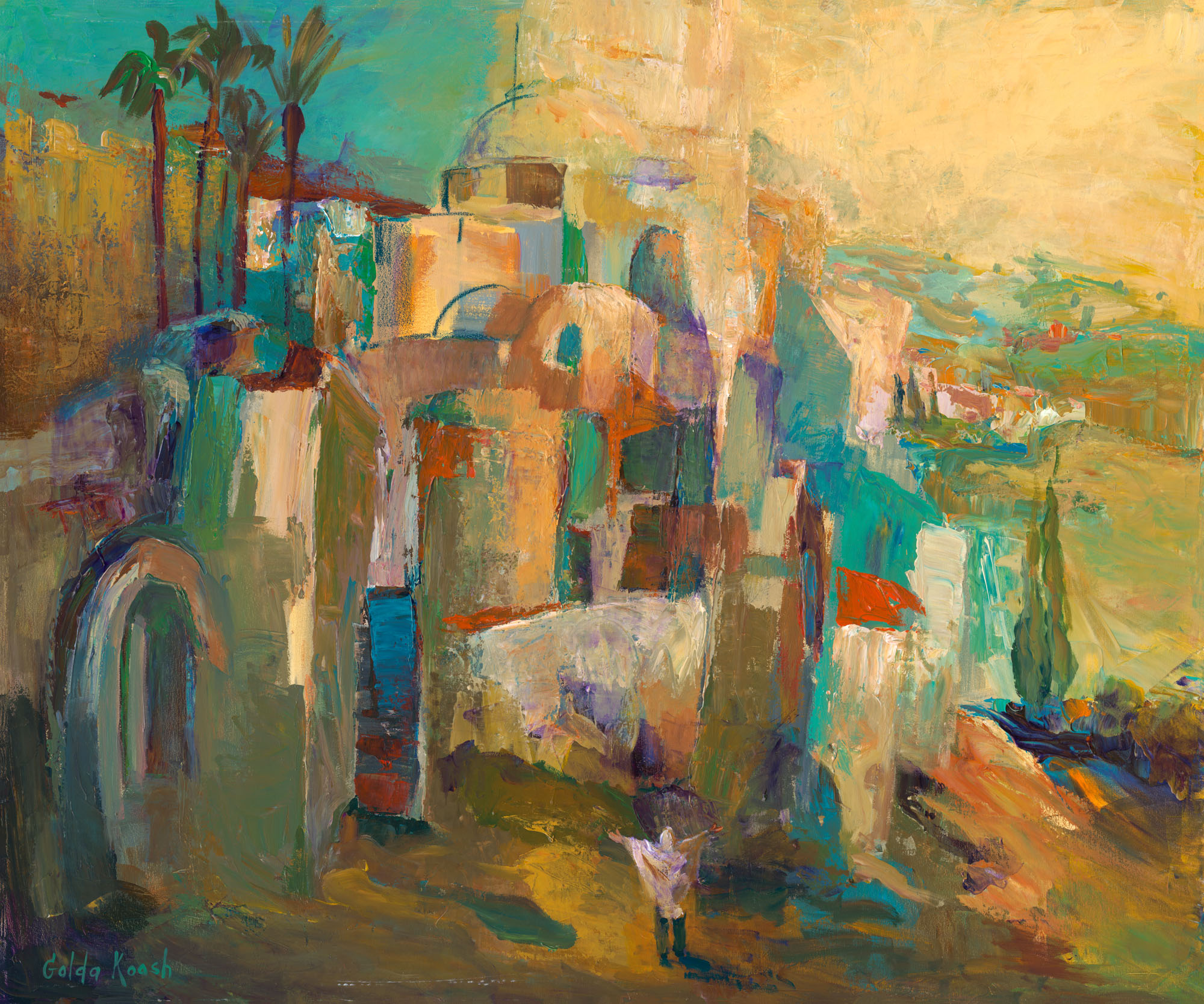
Golda Koosh spent ten years at the Moscow School of Arts, learning to see color, light, and form through the lens of classical training. But it wasn't until she arrived in Jerusalem that she truly learned what to paint. The Holy City changed her. It showed her the depth of Jewish tradition alive in daily life, not preserved in museums but lived in homes and streets and moments of prayer.
Moscow had given her the tools. Jerusalem gave her the reason. When she began painting Shabbat, she was painting something she had learned to understand through living in a city where Jewish faith and Jewish identity are woven into the landscape itself. Every alley, every stone, every Friday evening holds centuries of history and continuity. That weight, that beauty, that responsibility to remember and honor—it moved into her paintings.
Her early work explored the wide landscape of Jewish life. Synagogues. Jewish holidays. The people of Israel. But Shabbat became something different. It became personal. It became about the private sacred space, the home, the family gathered around a table. These are the paintings that moved her from being a skilled painter to being an artist who understands, in her bones, what she is documenting.
Faith and Identity in Every Brushstroke
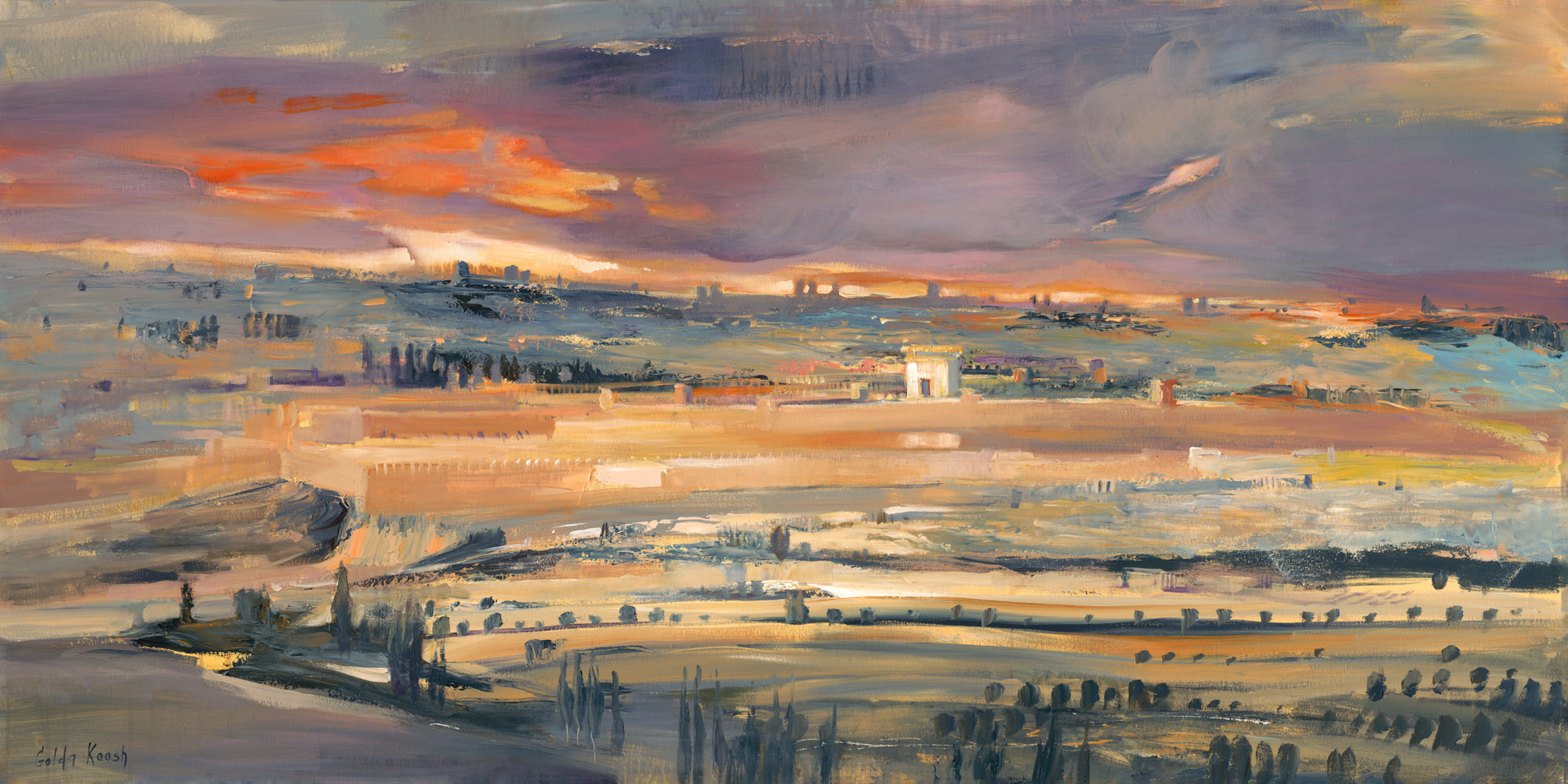
When Golda paints, she is not trying to create a pretty picture. She is trying to hold something true about Jewish life on canvas. Every brushstroke carries intention. The golds are not arbitrary. The way light falls on a tablecloth is not accidental. She studies how Shabbat actually feels, then translates that feeling into color and texture and composition.
Her paintings are never flat or decorative. They are layered. Mixed media elements—sometimes gold leaf, sometimes textured elements—create depth and movement. You can feel the Shabbat candles flickering in the way she applies color. You can sense the quiet conversation in the space between figures. Her brushwork is confident but warm, technical but never cold.
This is the hallmark of her approach to Shabbat art paintings. She respects the tradition enough to paint it carefully, but she paints it with joy, not solemnity. Shabbat is supposed to bring peace and pleasure. Her work shows both. The colors sing. The compositions breathe. There is celebration here, not just reverence.
Lighting the Shabbat Candles: The Moment of Transition
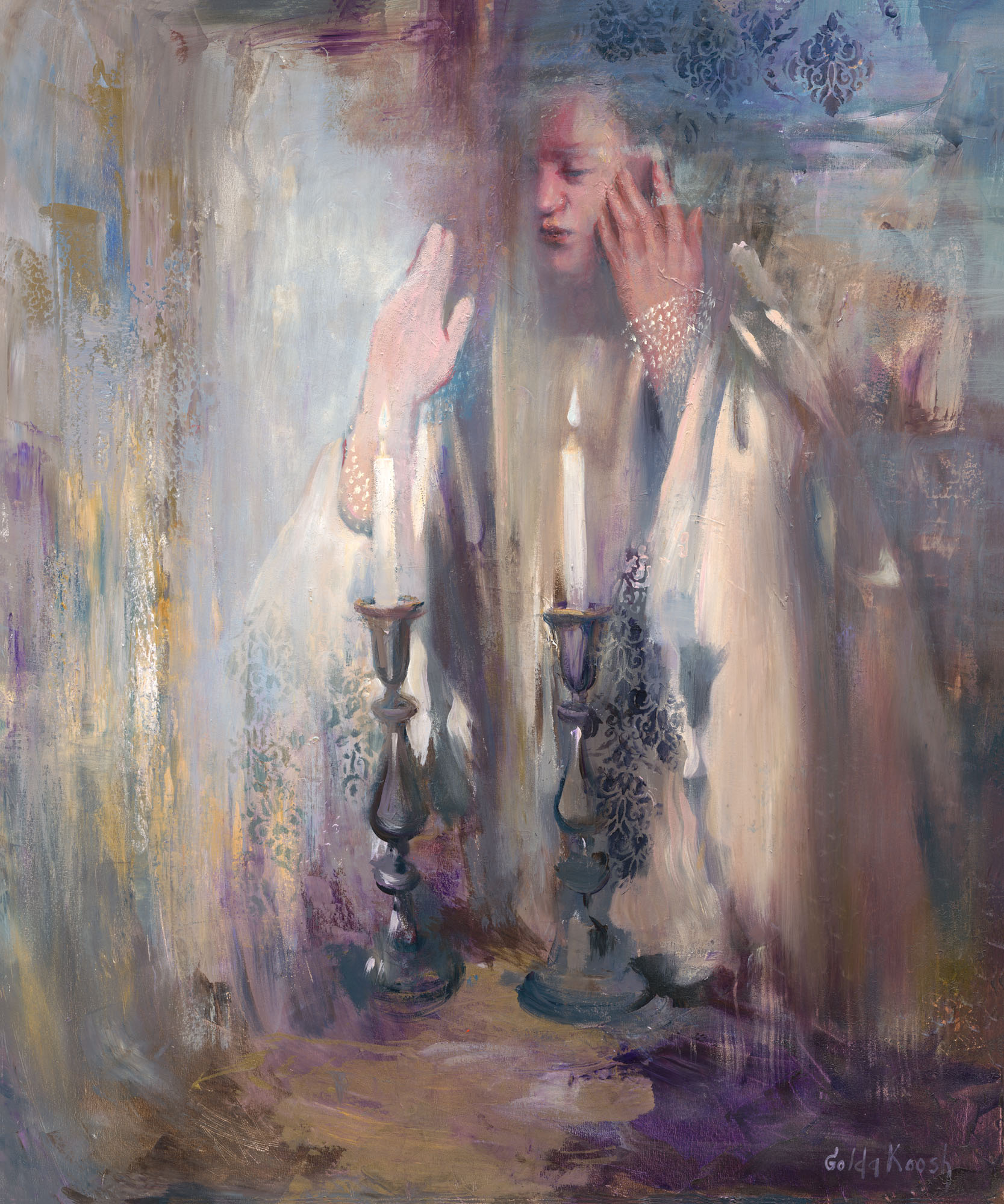
One of Golda's most recognizable paintings focuses on the instant before the candles are lit. In Lighting the Shabbat Candles, a woman's hands are poised above two candlesticks, and the entire painting seems to hold its breath. The table around her is warm with ochre and gold tones. The background recedes into deeper blues and purples. But the focus is on those hands and that moment of pause.
What makes this painting powerful is what it refuses to show. There is no artificial light. No bright modern kitchen. No distraction. The space is timeless, domestic, and utterly focused on one act. The brushwork around the figure is loose and expressive, suggesting movement and prayer and the weight of meaning that arrives with this simple gesture. You understand, looking at this painting, why Shabbat matters. It is not about rules. It is about choosing stillness.
The color palette in this painting—rich ochres, soft golds, deep indigo shadows—became a signature approach in Golda's Shabbat work. She learned in Jerusalem that Shabbat light is different from weekday light. It carries warmth and memory. Her paintings make that visible.
Collections and Themes
The Sacred Space of the Jewish Home
Golda understands that Shabbat is not something that happens in a synagogue for most Jewish families. It happens at home. It happens around a table. It happens in the space where a family gathers, where children sit beside grandparents, where food is blessed and shared. Her Shabbat paintings celebrate this domestic sacred space.
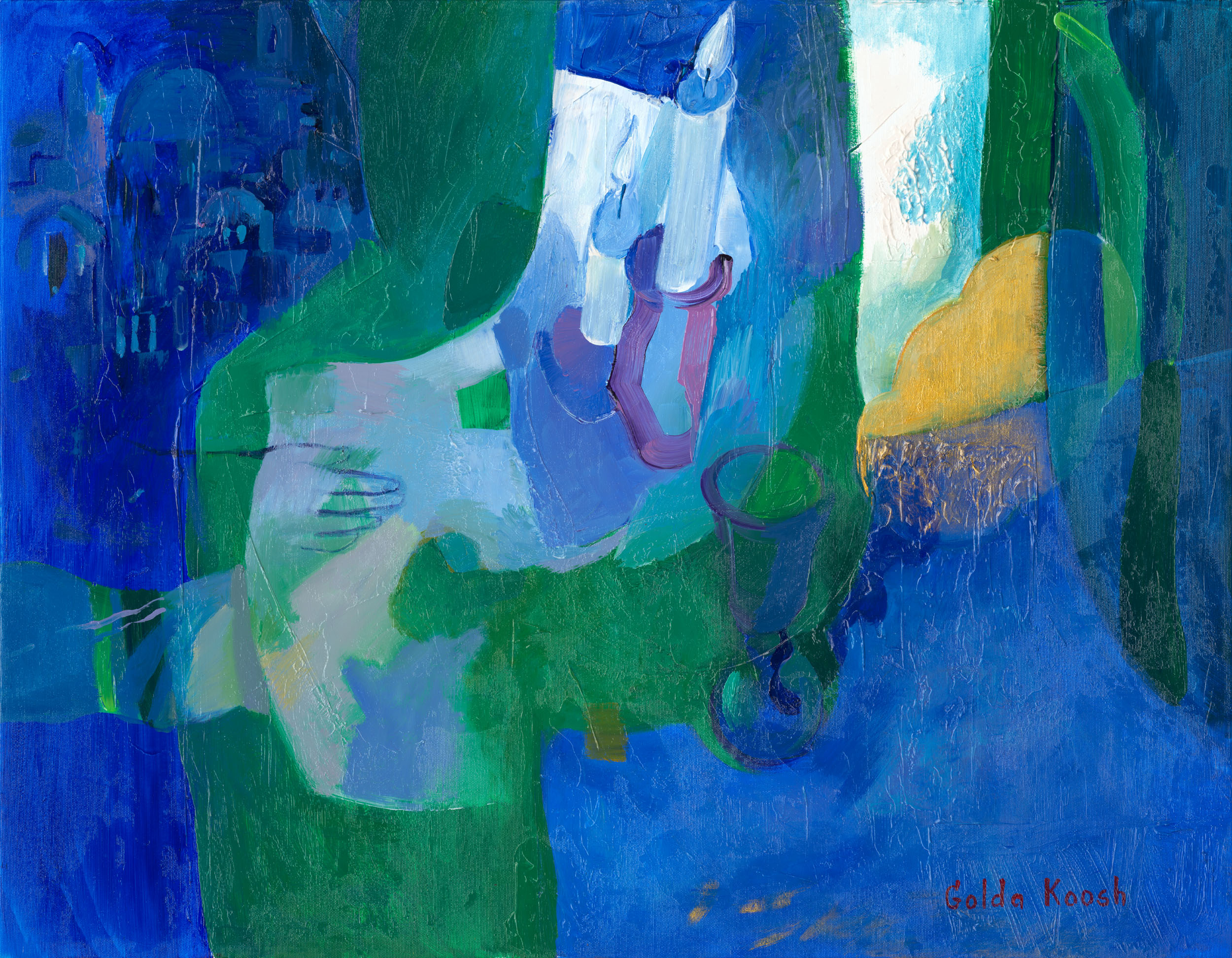
Many of her works in this collection focus on the table itself. Not as furniture, but as a stage where tradition unfolds. The challah. The wine. The candles. The plates and cups and the hands that move between them. Each element has meaning, and Golda's paintings show that meaning through careful attention to detail and atmosphere. The Shabbat Table is not a still life painting. It is a moment of life happening.
Her approach to the Jewish home has been shaped by years in Jerusalem, where she has watched how families gather, what rituals matter, what brings peace. You can feel her respect for these spaces in every painting. She is not an outsider documenting a tradition. She is a participant, painting from within.
Light as Spiritual Language
In Shabbat art paintings, light is everything. The moment the candles are lit, the spiritual quality of the space changes. Ordinary electric light stops mattering. The candle flames become the only light that counts. Golda has spent years learning to paint this transformation.
Her mixed media technique allows her to build light layer by layer. Gold leaf catches light in a way that printed colors cannot. Textured elements create shadows and depth that suggest the flickering of flames. When you stand in front of one of her Shabbat paintings, you are not just looking at an image. You are experiencing the effect of light itself.
This is why her Shabbat paintings work in homes. They do not just decorate a room. They participate in the room's spiritual atmosphere. Collectors often place them where Friday evening light can touch them, allowing the real light in their homes to interact with the light Golda has painted. The effect is subtle but real. The artwork becomes part of the Shabbat experience itself.
The Shabbat Table: Home as Sacred Sanctuary
In The Shabbat Table, Golda moves closer to the gathering itself. The composition is intimate. You are drawn into the scene, close enough to see the texture of the tablecloth, the warmth in the faces around the table, the way the candlelight touches each person differently depending on where they sit. The colors here are richer and more varied than in some of her other work. Deep crimsons. Soft creams. Gold that seems to glow from within.
What strikes you about this painting is how ordinary and sacred it manages to be at the same time. This is not a formal portrait. This is not a stiff representation of religious duty. This is a family gathered, and you can sense in the brushwork and composition that love is present. Golda has captured the thing that makes Shabbat meaningful to Jewish families—not the rules, but the connection.
The painting works as both a portrait of tradition and a meditation on home. It asks the viewer to remember their own table, their own Friday evenings, their own moments of peace and gathering. That is the strength of good Shabbat art paintings. They do not just show you something. They help you feel something you already know but sometimes forget.
The Emotional Language of Shabbat Art Paintings
How Shabbat Art Paintings Speak to the Soul
When you walk into a room where a Shabbat art painting hangs on the wall, something shifts. The pace of your breathing changes. Your shoulders relax. There is a quietness that settles over you, even if you did not consciously choose to feel it. This is what makes Shabbat art paintings different from other types of artwork. They are not trying to shock or challenge or make you think about something uncomfortable. Instead, they invite you into a space that feels safe, familiar, and deeply true.
Shabbat art paintings work through color and light rather than loud statements. A painting might show the soft glow of candlelight reflecting off a white tablecloth, or the way golden hour sunlight falls across a room where people have gathered to eat together. These visual elements bypass the thinking part of your brain and go straight to the heart. They remind you of sensations you have felt before, even if you cannot put those feelings into words.
The best Shabbat art paintings understand something important: peace is not the absence of everything. It is the presence of what matters. A well-painted Shabbat scene shows people, food, light, and connection. It shows abundance, but a quiet kind of abundance. The abundance of time spent together, of bread broken, of blessings spoken. This kind of visual storytelling creates an emotional experience that stays with you long after you have looked at the painting.
The Role of Heritage in Shabbat Art Paintings
Every Jewish family has its own version of Shabbat. Some families light candles in formal silver candlesticks. Others use simple glasses with candles inside. Some gather at large tables full of relatives. Others sit quietly with just one other person. Despite these differences, the feeling is often the same. There is a sense of stepping outside of time, of marking something sacred in your week.
Shabbat art paintings that capture genuine heritage do not try to show every Jewish family. Instead, they show one particular version of Shabbat truthfully, with such care and attention that viewers recognize their own experience reflected back at them. When you see a painting that shows Shabbat in a way that matches your family's tradition, something inside you opens. You feel seen. You feel like your way of doing things, your particular rituals and choices, matter enough to be painted.
Stories Written in Paint and Light
A Shabbat art painting is really a story. It might be a story about a single moment, but within that moment lives a whole narrative. Why is this table set this way? Who prepared the food? What prayers will be said? What conversations will happen? What dreams do these people carry?
When you look at a well-executed Shabbat art painting, your brain naturally starts asking these questions. You begin to imagine the hours that led to this moment. The shopping, the cooking, the cleaning, the deliberate choosing of what to wear. You begin to understand Shabbat not as a rule or a ritual, but as an act of creation. Every week, Jewish people around the world create a small island of peace and intention.
Paintings about Shabbat capture this creative act. They show the results, yes, but they also somehow convey all the love and intention that went into the creation. That is the mark of a painting that truly understands its subject.
Lighting the Shabbat Candles: A Moment Suspended in Time
There is something almost sacred about the moment when the Shabbat candles are first lit. In many Jewish homes, this happens on Friday evening as the sun begins to set. The painting captures this liminal moment, this threshold between the work week and the day of rest. The figure in the composition leans toward the candles with a kind of gentle devotion, her hands positioned in blessing.
The color palette of this painting uses warm ochre and gold tones that mirror the actual candlelight. The artist understands that when candles are lit, they do not just illuminate the space. They change the quality of light in the entire room. Shadows become deeper and more meaningful. Faces become softer. The painting conveys this transformation through careful brushstrokes that build warmth into every corner of the canvas. The figure is painted with such tenderness that you feel the weight of the moment, the significance of this weekly pause. This is not just a painting of a ritual. It is a painting of a woman choosing peace, week after week.
—
Collecting and Displaying Judaica Paintings
Choosing the Right Shabbat Art Painting for Your Space
When you are thinking about bringing a Shabbat art painting into your home, the first question is not "Is this a good painting?" The first question is "Does this painting speak to my version of Shabbat?"
Your home is personal. Your Shabbat is personal. The painting you choose should reflect that. If your Shabbat happens around a wooden farm table with mismatched chairs and loud voices, then a painting that shows a formal, silent, minimalist table might not feel true to you, even if it is beautifully painted. If your Shabbat is intimate and small, a painting showing a large family gathering might not resonate, even if it is technically excellent.
The right painting is one that makes you pause and think, "Yes, that is what it feels like." It does not have to show your exact situation. The people might be different, the room might be different, but the feeling should be familiar. When you stand in front of the right painting, something in you recognizes truth. That is when you know you have found a piece that belongs in your space.
Shabbat Table: Creating Visual Harmony in Your Home
This painting shows the Shabbat table from a perspective that invites you to sit down and join the gathering. The composition uses a classic view, as if you are approaching the table and about to take your seat. The artist has paid careful attention to the way light falls across the white tablecloth, creating depth and dimension through subtle variations of white, cream, and soft shadow.
The details matter in this painting. The challah bread is painted with enough specificity that you can almost smell the yeast and warmth. The wine glasses catch light in a way that feels natural and true. The candles glow with an internal warmth that seems to come from within the canvas itself. But what makes this painting particularly strong is the way it captures the emotional geography of the table. There are places for people. There is room for conversation. There is space for blessing. The painting communicates generosity and invitation through pure visual means. When you look at this painting, you understand what it means to be invited to a Shabbat table.
Placement and Lighting Tips for Fine Art Paintings
Where you hang a Shabbat art painting matters as much as the painting itself. These paintings work best in spaces where people gather. The dining room is an obvious choice, but so is a living room where family congregates, or even a bedroom where you might see it in quiet morning moments.
Natural light is ideal for viewing Shabbat paintings, but not direct sunlight, which can fade colors over time. Soft, diffused light allows you to see the full range of the artist's color palette. If you do not have natural light in your chosen space, consider installing a picture light above the painting. A good picture light will illuminate the work without creating glare or harsh shadows.
Think about what hangs near your painting as well. Shabbat paintings tend to work best alongside other meaningful objects. Family photos, a blessing written in calligraphy, or a simple shelf with meaningful items can all enhance the visual conversation that the painting creates. The space around the painting matters as much as the painting itself.
—
Jewish Art as a Gift and Heirloom
Meaningful Gifts for Jewish Celebrations
One of the most thoughtful gifts you can give to mark a Jewish celebration is a Shabbat art painting. Unlike flowers or food, which serve their purpose and fade, a painting lasts. It becomes part of the fabric of someone's home and their life. It marks the occasion of the gift, but it also marks every Shabbat that follows.
Consider giving a Shabbat art painting to celebrate a milestone. A wedding is an obvious occasion. A painting depicting Shabbat can speak to the couple about their new shared life and the traditions they will build together. A bat mitzvah or bar mitzvah is another meaningful time to give such a gift. It marks the moment when a young person steps into full participation in Jewish life. A painting about Shabbat says, "This is your birthright. This tradition belongs to you."
Even a birthday or an anniversary can be marked with a Shabbat art painting. If you are giving a gift to someone who lights candles each week, who gathers around a table, who values these traditions, then a painting that honors those practices is a gift that says "I see you. I recognize what matters to you."
Building a Family Art Collection Around Jewish Tradition
Some families start with one painting. That single work hangs in the dining room, and it becomes part of the visual landscape of weekly Shabbat. Over time, other pieces are added. Perhaps a painting about Jerusalem or Israel hangs in a different room. Maybe a work about Jewish celebration or dance adds vibrancy to another wall. What begins as a single painting gradually becomes a collection that tells the story of the family and their connection to Jewish life.
Building a collection does not require purchasing many pieces at once. Many families add paintings slowly, over years. Each piece is chosen carefully. Each work finds its place. Over time, the collection becomes a visual autobiography of the family's values, their travels, their spiritual journey.
The advantage of building a collection intentionally is that it creates coherence. The paintings speak to each other across the walls. They reinforce and amplify the themes that matter most to your family. When guests enter your home, they see not just individual artworks but a unified vision. They understand something essential about the people who live there: that tradition matters, that beauty matters, that connection matters.
—
Painting Collection Overview
Golda Koosh creates paintings that live within the world of Jewish tradition and celebration. Her collections include works focused on Jerusalem, the synagogue, Shabbat, biblical stories, and the spiritual landscape of Israel. Each collection is built around a central theme, but within that theme there is tremendous variety. You might find a quiet, intimate painting alongside a work full of movement and dance.
|
Collection |
Theme |
Medium |
Link |
|
Holy City, Sacred Spaces |
Painting & Mixed Media |
goldakoosh.com |
|
|
Prayer, Devotion |
Painting & Mixed Media |
goldakoosh.com |
|
|
Faith, Heritage |
Painting & Mixed Media |
goldakoosh.com |
|
|
Family, Celebration |
Painting |
goldakoosh.com |
The Shabbat collection, in particular, shows paintings that capture different dimensions of this sacred day. Some works focus on the candlelight moment. Others show the gathering of family. Still others depict the quiet hours of Shabbat afternoon. What unites them is a commitment to showing Shabbat as both a ritual and a felt experience. These paintings understand that Shabbat is not just something you do. It is something you feel in your body, in your spirit, in the way time itself seems to shift.
The Jerusalem collection gathers paintings about the city as a spiritual and physical place. These works include scenes of the Kotel, the streets of the Old City, and the light that falls across this sacred landscape. The synagogue collection shows paintings of Jewish prayer spaces, from grand sanctuaries to small, intimate rooms where prayers have been spoken for generations.
All of Golda Koosh's collections emphasize the role of light, color, and composition in creating an emotional experience. The paintings are created with mixed media techniques that allow for depth and luminosity. Brushstrokes are visible and intentional. Colors are chosen to evoke specific moods and feelings. The result is artwork that feels both formally accomplished and deeply personal.
—
Featured Highlight
Between Heaven and Earth: A Meditation on Sacred Connection
This painting sits in the space between the physical and the spiritual, between the everyday world and the transcendent. The composition uses layered brushstrokes to create a sense of movement and energy. Light seems to emanate from the center of the canvas, drawn from the deep gold and ochre palette that dominates the work.
The painting speaks to the nature of Shabbat itself, which is traditionally understood as a taste of the world to come. For six days, the Jewish calendar is oriented toward work, creation, and change. On Shabbat, that orientation shifts. Time becomes sacred. The ordinary becomes extraordinary. Between Heaven and Earth captures this transformation through pure visual language. The painting does not illustrate this idea literally. Instead, it creates the feeling of standing at a threshold, of moving between two states of being.
The mixed media technique used in this painting allows light to sit on top of the darker layers of color, creating a luminosity that draws the eye. The brushstrokes are visible and energetic, conveying a sense of spiritual movement. This is a painting that asks you to feel something rather than understand something. It asks you to recognize the sacred that is present in ordinary moments, in the spaces we move through every day, in the transformation that happens when we step outside of ordinary time.
Shabbat Art: How Golda Koosh Captures the Peace of Jewish Tradition
The Emotional Power of Shabbat Art Paintings
When you stand in front of a Shabbat art painting by Golda Koosh, you are not just looking at a picture. You are experiencing the artist's invitation to pause, to breathe, and to remember what matters. This is the gift of Shabbat art paintings—they do not ask you to think first. They ask you to feel.
The emotional resonance comes from how Golda captures the sensory details of the day. The glow of candles does not just illuminate a room in her paintings; it illuminates the soul. The warmth of gold and ochre tones wraps around figures like a blessing. You can almost smell the challah bread, almost hear the blessing over wine, almost feel the texture of the white tablecloth beneath your fingers. These are not distant religious images. They are invitations into moments you recognize, moments you long for, moments that speak to something deep inside you.
This is why Shabbat art paintings resonate across generations. A grandmother sees her own Shabbat table reflected back at her. A young person who has never observed Shabbat sees something beautiful and holy and wonders what it might feel like to experience that peace. A person far from home sees a portrait of belonging. Shabbat art paintings bridge the distance between where we are and where our hearts want to go.
Shabbat Art Paintings as Spiritual Practice
For many people, viewing Shabbat art paintings is itself a spiritual practice. When you spend time with these paintings, you are entering a slower space. You are stepping out of the hurried world and into contemplation. This mirrors the essence of Shabbat itself—a deliberate choice to slow down, to sanctify time, to remember that not everything is about productivity or achievement.
Golda Koosh understands this deeply. Her paintings are not meant to be glanced at and moved past. They are meant to be lived with. When a painting hangs in your home, it becomes part of your daily landscape. Every time you pass it, you receive a gentle reminder: there is holiness available to you right now. There is peace waiting. There is a tradition that has sustained millions of people through centuries, and you are part of it.
This is particularly powerful for people who feel disconnected from Jewish tradition or who are seeking to deepen their connection. Shabbat art paintings create a bridge. They offer a visual language for feelings that are sometimes hard to express in words. They say: this matters. This moment matters. Your presence here, now, in this quiet space—that matters.
Creating Space for Shabbat in Your Home
Many people who purchase Shabbat art paintings do so because they want to create a physical space in their homes where Shabbat feels real and present, even during the week. A painting hung in a dining room becomes a blessing over the table. A Shabbat art painting in a bedroom becomes a reminder to rest, to honor your body, to step away from screens and obligations.
Some people commission custom Shabbat art paintings that reflect their own family traditions. Perhaps your family has a specific blessing you love, or a memory of Shabbat that shaped who you are. Golda Koosh creates original paintings that can capture these personal stories, translating them into visual language that speaks to everyone who views them.
The colors matter too. When Golda chooses her palette—those warm golds and ochres, the deep blues of evening, the whites and creams of candlelight—she is creating a visual experience of peace. These are not jarring colors. They are colors that your nervous system recognizes as safe, as restful, as home.
The Universality of Shabbat Art Paintings
What is remarkable about Shabbat art paintings is their universality. Jewish tradition belongs specifically to the Jewish people, yet the themes Golda explores—rest, family, gratitude, the sacred in the ordinary—speak to something human that crosses all boundaries.
A Christian visitor might see in these paintings the same longing for Sabbath rest that exists in their own tradition. A secular person might respond to the beauty of ritual and gathering. Someone from a completely different culture might recognize the way a community comes together to mark time as holy.
This does not dilute the Jewish specificity of Shabbat art paintings. Rather, it shows how particular traditions, when rendered with authenticity and love, become windows into the universal human experience. Golda Koosh paints Jewish Shabbat because it is her tradition, her culture, her spiritual home. And in doing that with such integrity and artistry, she creates paintings that touch something true in anyone who encounters them.
Living with Shabbat Art Paintings
When you bring a Shabbat art painting into your home, you are not just acquiring a decorative object. You are inviting a presence. You are saying that this tradition, this moment, this way of being in the world matters enough to you that it deserves space in your daily life.
Over time, a relationship develops between you and the painting. You notice new details. You find yourself pausing in front of it at different moments—perhaps on a difficult day when you need reminding that peace exists, or on a joyful day when you want to celebrate what you have been given. The painting becomes a conversation partner, a witness to your life, a keeper of the sacred.
This is the truest power of Shabbat art paintings. They are not about the past, though they honor tradition. They are not about escape, though they offer respite. They are about bringing the peace of Shabbat into the present moment, again and again, week after week, year after year.
—
Conclusion
Shabbat art paintings capture something that cannot be rushed or manufactured—the profound peace that comes from honoring time as sacred, from gathering with people you love, from stepping away from the demands of the world and into the embrace of tradition. Golda Koosh's original paintings translate this feeling into visual form, using warm golds and ochres, intimate details, and spiritual depth to create works that invite contemplation and belonging.
Whether you are seeking to deepen your own Shabbat practice, create a spiritual anchor in your home, or share the beauty of Jewish tradition with others, Shabbat art paintings offer a way to make these values visible and present in your daily life. Each painting is a reminder that peace is available, that tradition connects us to something larger than ourselves, and that the ordinary moments—a table set with care, candlelight, the voices of loved ones—hold the greatest holiness.
Visit goldakoosh.com to explore Golda Koosh's Shabbat collection and discover how these original paintings can transform your space and deepen your connection to Jewish tradition. Whether you are drawn to a specific painting or interested in commissioning a custom piece that reflects your own family's traditions, you are invited to browse the full range of collections and inquire about available works. Each Shabbat art painting is created with intention, with respect for the tradition it honors, and with the hope that it will bring peace into your home.
—
Frequently Asked Questions
What kind of art does Golda Koosh create?
Golda Koosh creates original paintings and mixed media artwork that celebrate Jewish life, faith, and tradition. Her work is rooted in 10 years of study at the Moscow School of Arts, and as a Russian-Israeli artist based in Jerusalem, she brings both formal training and personal spiritual connection to her subjects. Her paintings explore themes of Jewish celebration, devotion, biblical stories, and the connection between Jewish identity and the Land of Israel. She does not create sculptures or prints—each piece is a unique original work. Her subject matter ranges from intimate Shabbat moments to vibrant celebrations, from the spiritual landscapes of Jerusalem to the expressions of Hasidic joy, from the stories of scripture to the everyday beauty of Jewish women and traditions. Her work is accessible to people of all backgrounds, speaking to universal themes of family, spirituality, rest, and belonging through specifically Jewish imagery.
What collections are available?
Golda Koosh offers multiple thematic collections that explore different aspects of Jewish life and heritage. The Jerusalem collection captures the spiritual heart of the Holy City, while the Kotel collection honors one of Judaism's most sacred sites. Her Synagogue collection depicts spaces of prayer and community, and the Hasidim collection celebrates the spiritual joy and movement of this tradition. For those drawn to music and celebration, the Klezmer/Dance collection brings infectious energy to canvas. The Biblical Stories collection brings scripture to visual life, and the Shabbat collection—perhaps her most beloved—captures the peace and holiness of the seventh day. Her Israel Landscapes collection showcases the beauty of the Land itself, while the Spirit of Israel collection explores deeper spiritual themes of connection and belonging. The Jewish Women collection honors the strength, grace, and spiritual power of women in Jewish tradition, and the Red Sea collection draws from the narrative of liberation and hope. The Chuppah collection celebrates marriage and new beginnings, while the Traditions collection encompasses the rituals and customs that bind Jewish communities together.
How can I purchase a Golda Koosh painting?
To purchase an original Golda Koosh painting, visit goldakoosh.com to explore her complete collections. Browse the different thematic galleries to discover which paintings speak to your heart and home. Each painting is an original work, not a print, making every piece unique. Golda Koosh paintings are available by inquiry, meaning you can request pricing and availability information directly through the website. If you have fallen in love with a specific painting, you can inquire about its current status. If you do not find exactly what you are looking for, Golda also creates custom commissions, allowing you to work with her to develop a painting that reflects your personal story, family traditions, or spiritual values. Whether you are purchasing for yourself, as a gift for someone you love, or to mark a special occasion, the team at goldakoosh.com can help guide you through the process and answer any questions about specific works.
What makes Judaica art a meaningful gift?
Judaica art serves as far more than decoration—it is a gift of connection, heritage, and spiritual meaning. When you give someone a Judaica painting like those created by Golda Koosh, you are giving them a window into their own tradition, a celebration of their identity, and a visual anchor for their values. For families, a Judaica painting becomes a heirloom, passed down through generations, carrying stories and blessings forward through time. Judaica art is particularly meaningful for major Jewish celebrations: a Bar or Bat Mitzvah gift that honors a young person's coming of age, a wedding gift that celebrates the formation of a new Jewish family, or a holiday gift that deepens connection to tradition year after year. For someone far from home or disconnected from their heritage, a Judaica painting can be a profound gift of reconnection. For those interfaith families blending traditions, Judaica art offers a way to honor and celebrate the Jewish dimension of family life. The personal nature of original artwork—the fact that it was created by an artist's hand, with intention and spiritual depth—makes it incomparably more meaningful than mass-produced items. A Golda Koosh painting says: your traditions matter, your heritage is beautiful, you belong to something sacred and enduring.