There is a world within Jewish life where every gesture carries spiritual weight. A man sways in prayer, his eyes closed, his lips forming words older than the stones around him. Another leaps into the air, arms flung wide, lost in a joy so deep it overflows into movement. This is the world of the Hasidim, and Golda Koosh paints it with a reverence and energy that few artists can match.
Her Hasidic paintings are not portraits of individual people. They are portraits of states of being — devotion so complete that the body forgets itself, joy so pure that it demands expression through dance. Each canvas vibrates with the intensity of lived spiritual experience, rendered by an artist whose classical training and Jerusalem surroundings give her the tools to make the invisible visible.
The Rebbe’s Joy
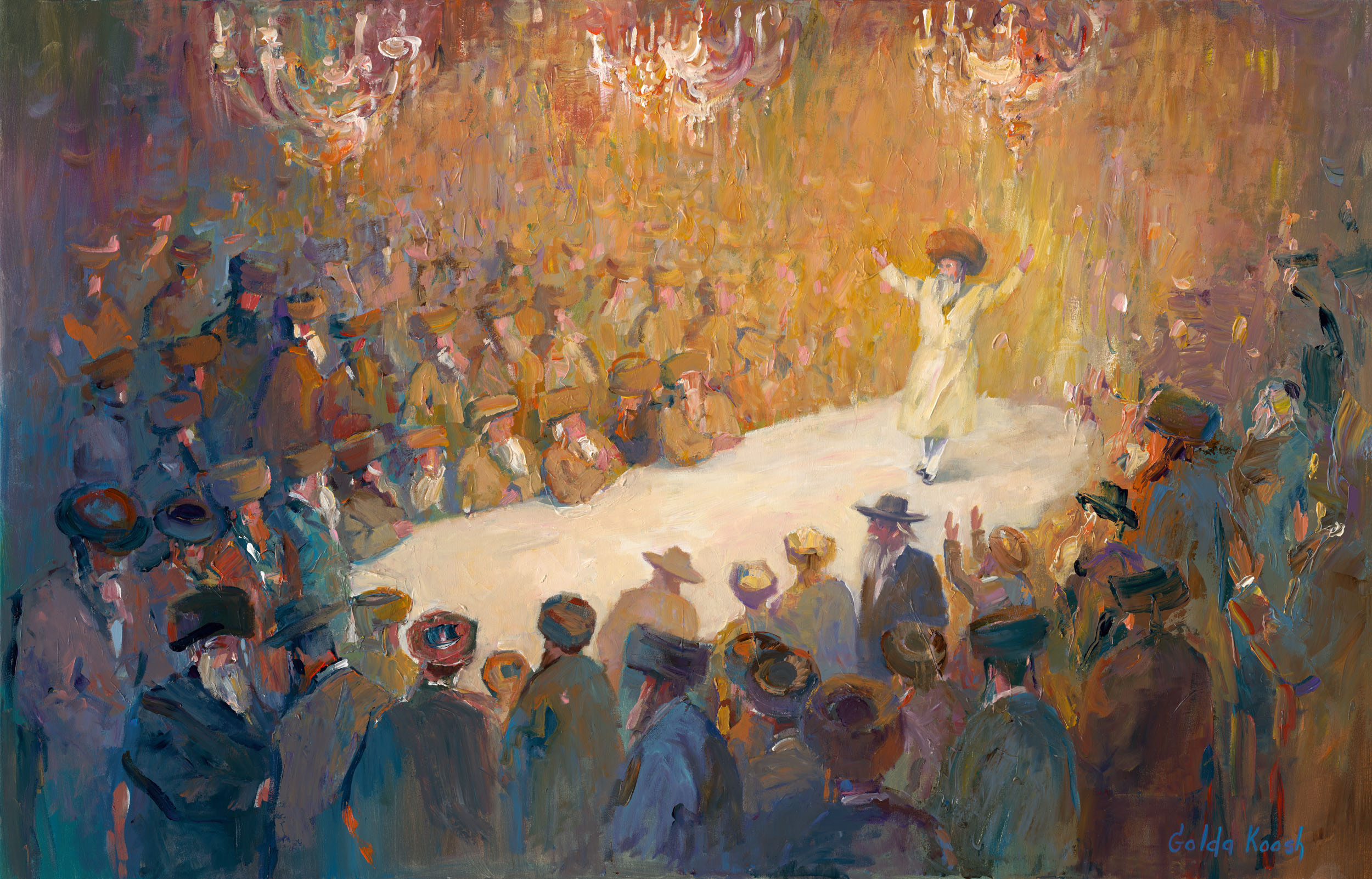
In The Rebbe’s Celebration, Golda captures a moment of communal ecstasy. The Rebbe stands at the centre of a whirlwind of movement — figures dancing, swaying, and reaching toward him and toward heaven. The composition radiates outward from the central figure like a living mandala, drawing every element of the scene into a single unified act of celebration.
The colour palette is warm and deep: rich ochres, burnt sienna, flashes of gold that suggest candlelight and sacred fire. Golda’s brushwork is deliberately loose, each stroke conveying speed and emotion rather than precise detail. The effect is kinetic. You feel the music in this painting before you understand what you are seeing. It is a celebration not just of the Rebbe but of the unbreakable bond between teacher and community, between the individual soul and the collective spirit of faith.
Prayer as Connection

If celebration is one pole of Hasidic life, deep prayer is the other. Divine Connection: Hassidic Men Praying in Synagogue captures a group of men wrapped in tallitot, their bodies bent toward the sacred texts before them. The atmosphere is one of intense concentration, each figure absorbed in a private dialogue with the divine even as they stand shoulder to shoulder.
Golda’s handling of light in this painting is extraordinary. A soft, golden glow emanates from the centre of the composition, suggesting the presence of something beyond the physical. The surrounding tones are muted — deep browns, soft greys, warm whites — allowing the light to draw the viewer’s eye toward the spiritual core of the scene. Her ten years of training at the Moscow School of Arts are fully on display here, in the controlled gradations of tone and the atmospheric depth that gives the synagogue interior its weight and presence.
A Night of Sacred Joy
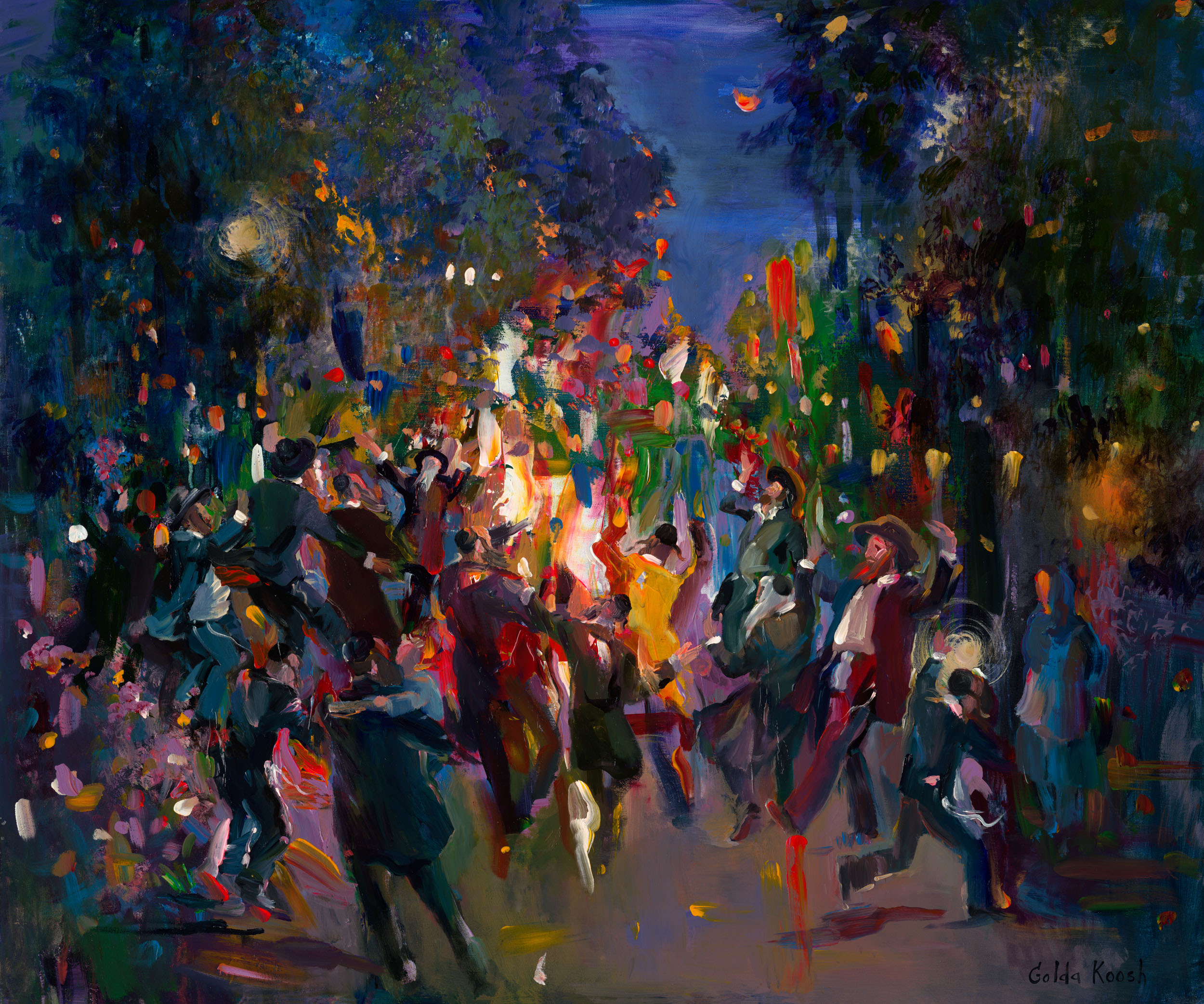
Simchat Beit Hashoevah: A Night of Joy depicts one of the most exuberant celebrations in the Jewish calendar. During Sukkot, the Water Drawing Festival transforms the night into a spectacle of music, dance, and unbridled happiness. Golda paints this scene with an energy that threatens to spill beyond the edges of the canvas.
Figures leap and spin in cascading circles, their black coats and white shirts creating a dynamic contrast that amplifies the sense of motion. The background glows with warm amber and gold, evoking torchlight and the electric atmosphere of hundreds of voices raised in song. Golda’s expressive brushwork translates the rhythm of the music into visual movement, each stroke a beat, each colour a note. It is a painting that does not merely represent joy but generates it.
Why Hasidic Art Belongs in Every Collection
Golda Koosh’s Hasidic paintings capture something essential about the Jewish spirit: the conviction that worship and joy are not opposites but partners. Whether in prayer or in dance, the Hasidim express a relationship with the divine that is physical, emotional, and utterly alive. These paintings bring that energy into any space they inhabit.
Browse the full Jewish Heritage collection or explore all collections at goldakoosh.com. To inquire about an original painting, visit goldakoosh.com/contacts or call +972506689640.