Imagine ancient Jerusalem’s stones framing a young woman’s happiest moment. This is what Golda Koosh’s stunning Jewish bride painting shows. It brings together centuries of tradition and a single, precious moment.
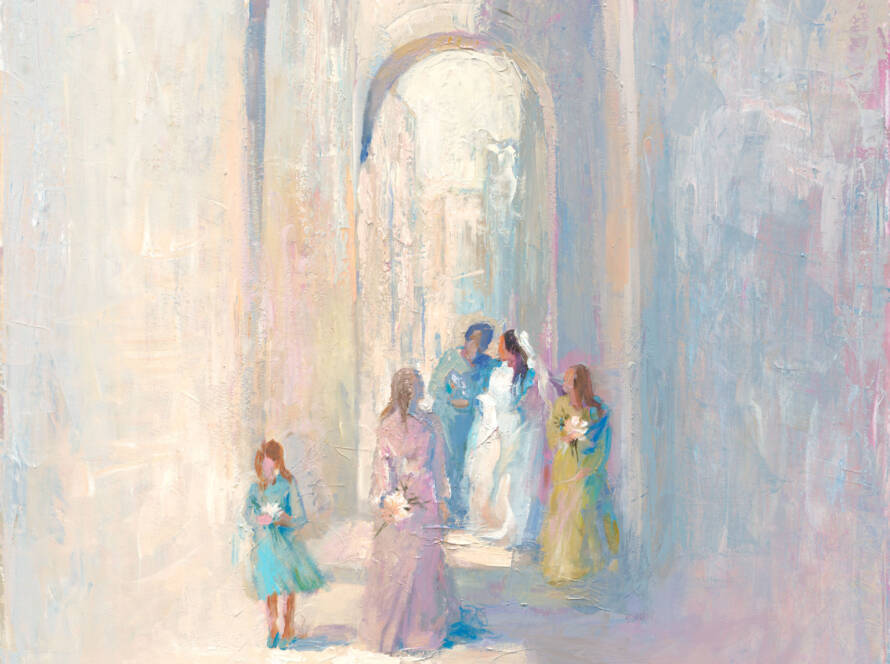
The painting shows a bride walking through Jerusalem’s Old City. It’s bathed in soft pastel colors, making stone archways look like gateways of blessing. It’s more than just a wedding day; it’s the eternal bond between faith and art in Jewish celebrations.
Koosh’s brushstrokes blend past and present under ancient arches. This sacred Jewish artwork touches the hearts of people across generations. It shows how old rituals bless new love stories. Every color and light tells a story of hope and continuity.
The painting takes us to a place where spiritual heritage meets personal joy. With delicate impressionistic techniques, it opens a window into Jewish tradition. It shows how faith and art come together to create moments of beauty beyond words.
Key Takeaways
- Golda Koosh’s painting captures a bride’s procession through Jerusalem’s Old City with ethereal beauty.
- The artwork blends soft pastel colors with ancient stone architecture to create a dreamlike atmosphere.e
- Sacred Jewish artwork preserves the eternal connection between tradition and contemporary celebration.
- The painting demonstrates how faith and art unite to document life’s most precious moments.
- Ancient Jerusalem serves as both setting and witness to modern Jewish wedding traditions.
- Impressionistic techniques transform a wedding scene into a spiritual masterpiece.e
A Sacred Vision: The Jewish Bride Painting “Bride in the Old City” by Golda Koosh
The Jewish bride painting “Bride in the Old City” is a standout piece by Golda Koosh artist. It turns a wedding into a timeless, sacred vision artwork. It blends old traditions with new art, showing joy and heritage in Old City Jerusalem.
The Ethereal Scene Beneath Ancient Stone Archways
Stone archways surround the bride, telling stories of many generations. The Golda Koosh artist shows light through these archways, making pools of light. These archways link the past and present, earthly joy and divine blessing.
Soft Pastel Colors Creating a Dreamlike Atmosphere
Soft blues, pinks, and yellows cover the canvas like morning light in Old City Jerusalem. These colors make the Jewish bride painting seem like a dream. They show the softness of love and the lasting nature of sacred vows.
The Wedding Party’s Procession Through Jerusalem
The procession moves through narrow passages, their joy echoing off the walls. Family and friends surround the bride, their figures moving in celebration. This sacred vision artwork shows how personal joy becomes a shared blessing, a personal moment becomes a cultural tradition.
Jerusalem as the Sacred Canvas for Life’s Most Precious Moments
Jerusalem’s ancient walls hold centuries of prayers and celebrations. It’s more than a backdrop for weddings; it’s a key player. The city’s streets and archways turn into a living gallery, where joy and devotion come alive.
The Spiritual Significance of the Old City Setting
The Old City has a special spiritual vibe that makes every wedding special. Each quarter, like the Jewish Quarter, adds to the religious depth. Being close to the Western Wall and synagogues makes the atmosphere holy.
Couples here link their love to thousands of years of faith. It’s a powerful connection to tradition.
Ancient Stones Witnessing Modern Celebrations
The limestone walls have seen generations of Jewish families celebrate. Where King David walked, today’s wedding songs fill the air. Jerusalem’s art shows how old and new love stories blend.
This mix of old and new tells a story of lasting love.
The Holy City’s Role in Jewish Wedding Traditions
Jerusalem is key in Jewish wedding customs. The glass breaking reminds us of the Temple’s fall. The chuppah ceremony gains meaning where the Temple stood.
Many couples say Shehecheyanu blessings. They thank God for bringing them to this holy place.
The Impressionistic Style: Capturing History and Joy in Traditional Jewish Wedding Art
The soft brushstrokes and gentle edges of impressionistic Jewish painting bring ancient wedding scenes to life. They turn stone archways into soft clouds of light and shadow. This artistic style captures the joy of the moment while honoring long-standing traditions.
In traditional Jewish wedding art, the impressionistic style does more than just look good. Artists like Golda Koosh use loose, expressive techniques. They make us feel the joy of wedding processions and the warmth of blessings under sacred canopies. Each brushstroke adds emotional depth, touching both heart and soul.
| Impressionistic Elements | Symbolic Meaning | Visual Impact |
| Blurred boundaries | Unity of a couple | Dreamlike quality |
| Light dissolving forms | Divine presence | Ethereal atmosphere |
| Soft color transitions | Life passages | Emotional resonance |
| Textured surfaces | Ancient stones | Historical depth |
This style in historical celebration art connects the past and the present. It makes today’s couples see themselves in ancient traditions. Colors blend like generations merge, creating art that speaks to love, faith, and commitment across time.
Symbolism of Light and Architecture in Jewish Ceremonial Art
The sacred spaces of Jerusalem turn into living canvases. Here, light and shadow art blend with ancient stone. Every beam of sunlight has meaning, and each archway has a story.
The bride’s walk through these wonders is like a visual prayer. Symbolic Jewish artwork brings life to the stone and mortar.
The Interplay of Natural Light Through Stone Passages
Jerusalem’s golden hour brings radiant beams through weathered archways. This creates stunning light and shadow art on the bride’s white gown. It turns the scene into a symbolic Jewish artwork, where divine presence meets earthly joy.
The sun filters through ancient openings, painting geometric patterns on cobblestones. Each ray is a blessing, and each shadow is a moment of reflection in this masterpiece of Jewish ceremonial art.
Architectural Elements as Metaphors for Life Transitions
Stone archways frame the bride’s journey, symbolizing the transition from single to married life. These ancient passages have seen many celebrations, holding memories of generations. The curved stonework creates natural frames, each arch representing a threshold crossed.
In this symbolic Jewish artwork, columns stand as guardians of tradition. Vaulted ceilings suggest infinite possibilities ahead.
The Bridge Between Past and Future
The Old City’s pathways connect ancestral wisdom with modern love stories. This architectural symbolism weaves through the painting, where ancient foundations support new beginnings. The bride walks where prophets once walked, her celebration honoring timeless customs.
Jewish ceremonial art captures this sacred continuity. Yesterday’s prayers echo in today’s vows.
The Artist’s Vision: Golda Koosh’s Journey from Moscow to Jerusalem
Golda Koosh’s journey started in Moscow’s rich cultural scene. She grew up around grand museums and galleries. These places taught her about art’s long history.
The State Tretyakov Gallery and Pushkin Museum were her classrooms. Masterworks there shaped her vision. This early exposure influenced her Jewish identity and art.
In 1989, she joined the Moscow School of Arts. This marked a decade of learning. The school mixed old techniques with new ideas.
Her teachers saw her talent. They noticed her skill in combining technique with emotion. During this time, her unique style began to take shape.
| Career Milestone | Location | Artistic Focus |
| 1989-1999 | Moscow School of Arts | Classical Training and Technique |
| 2000-2021 | European Galleries | International Exhibition Period |
| 2022-Present | Jerusalem | Bride Portrait Judaica and Sacred Art |
Her work was a hit in Russia, Europe, Britain, and America. But she felt a deeper call. Jerusalem called to her, not just for shows, but as home.
The Weight of History Meets New Beginnings in Bride Portrait Judaica
In Jerusalem’s ancient walls, modern couples write their own sacred chapters. This bride portrait Judaica shows a deep truth: every Jewish wedding is part of a long chain. Stone archways now frame moments of contemporary Jewish love, connecting past and present.
Ancient Jerusalem as Witness to Contemporary Love
The Old City’s stones have seen empires rise and fall. Yet, they witness the most intimate human celebrations. Today’s brides walk paths where matriarchs once walked, their white gowns catching light.
This Jewish tradition art shows how ancient Jerusalem welcomes modern romance. The city’s timeless architecture blesses and connects each new union.
The Continuity of Jewish Tradition Through Generations
Each brushstroke in this sacred marriage art links yesterday’s ceremonies with tomorrow’s promises. Grandmothers see their own weddings in granddaughters’ joy. Fathers recall their own steps toward the chuppah as they guide daughters.
The painting shows how Jewish wedding customs stay vibrant and meaningful. They adapt to each generation while keeping their holiness.
Sacred Spaces Transforming Personal Moments
Jerusalem’s holy sites turn personal celebrations into communal memory. Private vows become part of the collective heritage in these sanctified spaces. These locations make personal milestones spiritual experiences that echo beyond the couple.
Universal Themes of Love, Tradition, and Blessing in Jewish Wedding Canvas
The Jewish wedding canvas goes beyond cultural lines but stays true to ancient roots. Each stroke of paint conveys feelings that touch all kinds of hearts. It blends universal love with Jewish traditions, making art that speaks to everyone, no matter their faith.
In matrimonial Jewish art, some symbols mean the same to everyone. The bride stands for new starts, hope, and the future. Jerusalem’s old stones mean lasting love and strong bonds. Light through arches shows God’s blessing on the couple. These symbols talk to people from all walks of life, yet keep Jewish traditions alive.
Traditional blessings art uses timeless motifs in the painting:
| Universal Theme | Jewish Expression | Symbolic Meaning |
| Eternal Love | Chuppah Ceremony | Sacred covenant between souls |
| Community Joy | Wedding Procession | Collective celebration of the union |
| Divine Blessing | Jerusalem Setting | Heavenly witness to vows |
| Future Hope | White Bridal Garments | Purity and new beginnings |
The Jewish wedding canvas speaks a language of love that everyone understands. People from different places see their own joy in these sacred moments. It connects old wisdom with today’s hearts, showing love’s promise is forever.
The Artistic Heritage: Influences from Chagall’s Jewish Bride to Contemporary Visions
Jewish wedding portraiture has a long history, filled with beauty and tradition. Marc Chagall’s floating brides and today’s artists keep this tradition alive. They bring the magic of marriage to life through their art.
The Legacy of Jewish Wedding Portraiture
The Chagall Jewish bride is a timeless symbol in art. His dreamlike scenes show love’s power. Artists before him, like Moritz Oppenheim and Isidor Kaufmann, also captured Jewish ceremonies with great care.
They showed us the beauty of tradition, costumes, and rituals. Their work is more than just pictures; it’s a window into a world of heritage.
Modern Interpretations of Classical Themes
Today’s artists give new life to old themes. They place brides in modern Jerusalem, blending old and new. The art now uses soft colors and movement to show emotions.
The Evolution of Jewish Bridal Illustration
Art keeps changing, yet its heart stays the same. Digital artists mix old and new, using new colors and views. They show brides in ancient places, yet their joy feels modern.
This mix of old and new makes today’s Jewish bridal art special. It speaks to our past and our hopes for the future.
Golda Koosh’s Artistic Collections: Celebrating Jewish Identity Through Color
The world of Golda Koosh collections is full of color and spirit. Each piece is a journey through Jewish identity art. Koosh uses four main colors to show the joy and depth of Jewish life.
From quiet prayer moments to big celebrations, Koosh’s art captures it all. Her work is a celebration of Jewish traditions and life today.
The Blue Collection: Playfulness and Celebration
Blue fills Koosh’s canvases like the sea meets Jerusalem’s walls. This series is all about joy, like Klezmer music and parties. Every Jewish wedding portrait shines with blue, reminding us of prayer shawls and evening prayers.
The Red Collection: Passion and Devotion
Red paintings show wine blessings and sunset prayers. They speak of hearts full of faith. Koosh turns everyday moments into sacred ones with her art.
The Gold Collection: Sacred Illumination
Golden touches light up Torah scrolls and wedding canopies. This series brings warmth, like sunrise prayers in Jerusalem and candlelit tables on the Sabbath.
The Green Collection: Growth and Renewal
Green celebrates spring and new starts. Gardens and dancing figures bloom, symbolizing growth and tradition.
| Collection | Primary Themes | Symbolic Elements |
| Blue | Joy, Celebration | Klezmer musicians, Dancing figures |
| Red | Passion, Faith | Wine cups, Sunset prayers |
| Gold | Sacred moments | Torah scrolls, Candle flames |
| Green | Renewal, Growth | Olive branches, Spring blooms |
The Jewish Wedding Portrait as a Window to Cultural Heritage
A Jewish wedding portrait is more than a photo; it’s a living piece of history. It shows centuries-old traditions that have been passed down for generations. Each stroke of the brush holds the stories of the past, keeping them alive for today’s couples.
These portraits connect today’s couples to their ancestors. They show how families have celebrated love for centuries, from Eastern Europe to the Middle East.
Cultural heritage art is deeply personal in wedding images. The bride’s dress, the objects used in the ceremony, and the family gathering all tell a story. Artists who create these works are like guardians of culture, keeping memories alive through their art.
The traditions shown in these portraits are timeless. They include:
- The chuppah symbolizes the couple’s new home
- Prayer shawls connecting earthly celebration to divine blessing
- Breaking of the glass, remembering the fall of the second temple, even in moments of joy
- Dancing circles representing community embrace
Each portrait teaches future generations about their heritage. Children learn about their family’s traditions through these images. Museums and collectors see the value in these works, knowing they preserve history and culture.
By preserving these portraits, we keep Jewish traditions alive. They inspire and guide new families, building their futures on ancient values.
Acquiring This Masterpiece for Your Collection
Buying “Bride in the Old City” is more than just a purchase. It’s about owning a piece of Jewish ceremonial art with deep history and spiritual value. It’s a chance to protect cultural treasures that touch both personal faith and universal human experiences.
The Significance of Owning Original Jewish Ceremonial Art
Original Jewish artwork connects the past with today. It turns homes into galleries filled with meaning. Each piece reminds us of our heritage, thanks to the artist’s unique touch.
Investment in Cultural and Spiritual Heritage
Investing in art like Golda Koosh’s work is more than just money. It’s about keeping stories, rituals, and celebrations alive for the future. These pieces become part of family history, cherished at gatherings and quiet moments.
Display and Preservation Considerations
Proper care is key to keeping your original Jewish artwork looking great for years. Here are some important tips:
- Keep artwork away from direct sunlight to prevent fading
- Keep humidity levels between 40% and 60%
- Use archival framing with UV-protective glass
- Get professional cleaning every few years
For advice on adding this Jewish ceremonial art to your collection, contact the artist at +972506689640 or visit goldakoosh.com/contact.
Conclusion
“Bride in the Old City” is a shining example of the blend of faith, love, and art. This Jewish bridal illustration is more than just a picture. It opens a window into the heart of Jewish celebrations. Golda Koosh’s artwork shows the special moment when ancient Jerusalem meets a modern bride.
This moment is filled with tradition and new beginnings. It’s when divine presence meets human happiness. This masterpiece is not just for its beauty. It brings the prayers of generations and the beauty of Jerusalem into your home.
Each stroke of the brush carries history and celebrates love. The painting speaks to those who find meaning in tradition. It shows that some stories are told in colors and light.
If you’re interested in this piece or want to see more of Golda Koosh’s work, you can contact her at +972506689640. Visit goldakoosh.com/contact to start your journey into a collection that honors heritage and hope. “Bride in the Old City” is not just a painting. It’s a bridge that connects the past with the present, ancient stones with beating hearts, and eternal Jerusalem with your story of faith and love.
FAQ
What makes “Bride in the Old City” a significant piece of Jewish bride painting?
This masterpiece by Golda Koosh is special because it mixes ancient Jerusalem’s beauty with today’s wedding joy. It shows a wedding procession under the Old City’s archways. The soft colors and light make it feel like a dream where old traditions meet new happiness. This painting is not just art. It’s also a spiritual document. It keeps the sacredness of Jewish weddings alive, set against Jerusalem’s timeless stones.
How does traditional Jewish wedding art typically portray ceremonial moments?
Traditional Jewish wedding art is full of deep meaning. It shows the spiritual and emotional sides of weddings. Artists have always captured the special bond between divine blessing and human love. They use symbols like chuppahs and Jerusalem images. These artworks are like prayers. They turn canvas into a sacred place where earthly joy meets heavenly joy.
What distinguishes Golda Koosh’s approach to bride portrait Judaica from other artists?
Koosh’s style is unique. She brings a mix of Moscow’s art and Jerusalem’s spirituality to her work. Her impressionistic style captures history and celebration with soft brushstrokes. She studied for ten years in Moscow before moving to Jerusalem. Her art is both technically skilled and emotionally deep. It speaks to beauty and truth.
How does the Chagall Jewish bride tradition influence contemporary artists?
Marc Chagall changed how Jewish weddings are seen in art. His floating figures and dreamlike colors opened new ways to show Jewish love. Today’s artists use this as a base, adding their own twist. They keep the tradition alive while making it fresh for today. This keeps the tradition vibrant and meaningful.
What should collectors consider when acquiring a Jewish wedding canvas?
Collectors should look at the art’s value and spiritual meaning. Think about how it connects to Jewish tradition. The artist’s background and cultural authenticity matter too. Keeping the art in good condition is key. This means controlling light and humidity. Buying such art is a way to preserve culture and add beauty to your space.
Where can one view or purchase authentic Jewish wedding portraits?
Golda Koosh’s original works, like “Bride in the Old City,” can be seen by contacting her. Call +972506689640 or visit goldakoosh.com/contact. Her art covers many themes, from playful to sacred. Each piece is a chance to own a piece of Jewish tradition. It connects ancient customs with today’s art.
What role does Jewish bridal illustration play in preserving cultural memory?
Jewish bridal illustrations keep tradition alive. They show the connection between Jewish people and their heritage. These artworks document how weddings have changed over time. They keep the spiritual values of weddings alive. Artists capture the details and emotions of Jewish weddings. This helps future generations understand and cherish these traditions.